Main

May 2, 2008

have read/will read dept.

I will still probably post here more days than I don't (so keep checking back!), but I'm gonna take a small step back from the blog for the next few weeks, at least. I need to do some writing for myself and only myself. Been a while.

o Robert Rich's response to Kevin Kelly's 1000 True Fans theory.
o A BusinessWeek profile of Other Music, the awesome Manhattan record store whose new release bin (and equivalent section in their newsletter) is probably the most discerning review section in the country.
o While at school in Ohio, a friend and I joked about running a pipeline from New York to bring a supply of tap water for proper pizza and bagels. Kottke looks into it.
o The NYRB gets loose on Wikipedia. Looking forward to sinking into this one.
o With all the insidious cross-marketing, yadda yadda, sometimes it's a relief to know that the Man often still just doesn't get it.
o Dmitri Nabokov is going to publish The Original of Laura. Yay!

May 1, 2008

the last verse & "honey in the rock" - blind mamie forehand

"Honey in the Rock" - Blind Mamie Forehand (download) (buy)
from Goodbye Babylon (1927/2003)

(file expires May 8th)

Burkhard Bilger's recent New Yorker piece, "The Last Verse," is excellent -- the type of typically sprawling think-piece/profile that could end up in a future Da Capo Best Music Writing edition. But it also bummed me out. "Is there still any folk music out there?" the subhead asked. It's an endlessly fascinating question, but -- if you limit "folk" to its literal definition -- the answer becomes equally limited.

For his own recordings, Rosenbaum laid down only a few ground rules. The musicians could come from anywhere and play almost anything: fiddles, guitars, washboards, or spoons; harmonicas, Jew's harps, or accordions. (In one recording, a broomstick kept time; in another, a pick-axe.) But the songs had to be traditional, the music learned from relatives or local musicians. He wanted folksingers, as he puts it, not just singers of folk songs.

And, thus, another story about dudes driving the South around looking for old performers and older records. But folk music is more alive than that, pulsing from car stereos and ringtones in the centuries-old rhythms at the core of reggaeton, or in the magpie strategies of the bootleg/mash-up world. Even if hip-hop is the very definition of mass culture -- see, for example, the ridiculous Jay-Z/Soulja Boy feud being played through the NBA -- it still requires an intricate constellation of references to understand it, many of which can only be passed person to person. While there's plenty that comes through media, there's still plenty of slang that can trace back decades, if not more.

The answer to Bilger's question is unquestionably, "yes." A truly oral culture is no longer possible, but we have something else -- a world where text is so plentiful it becomes both meaningless and ephemeral. How does one collect it?

April 17, 2008

useful things, no. 12

The twelfth in an ongoing collection of functional webpages and-dork- like tools (excluding any/all Google programs)

o The new and old bins at WFMU, complete with notes from music director Brian Turner and other DJs.

o More online mixing at muxtape.

o Melodyne promises "direct note access" polyphonic sampling. I suspect technology like this might be similar to alchemy or divining rods, but I'm sure it'll work for some people.

o Notable digital archives from newspapers and magazines, for free and for pay.

o Omnisio allows the user to make YouTube playlists which join together multi-part movies.

o Scribd is a free OCR scanning service.

o Sorry, a break with the self-imposed ban on Google tools 'cause it's too cool: GoogleEarth now layers current New York Times headlines over its maps, so one can read the news geospatially.

April 15, 2008

links of dubious usefulness, no. 18

o A massive archive of Sonic Youth bootlegs and side projects.
o Garfield minus Garfield.
o Brian Dettmar's gorgeous book autopsies.
o Product vs. Reality comparisons.
o Philosopher John Rawls on baseball.

April 10, 2008

have read/will read dept.

These mostly fall on the latter side of the above equation. Definitely need to make some time soon to catch up on my links.

o Two pieces about what Murakami is up to.
o Cory Doctorow on multitasking and disruption.
o Recent semi-interview (circa, uh, last week) with Eye and Yoshimi from the Boredoms all about the new Super Roots disc. (Big ups, Whiney!)
o GQ begins to untangle JB's wreckage.
o Alan Bishop on his Sun City Girls brother, the late Charles Gocher.

April 1, 2008

moving entertainments

Trippy '60s filmmaking #1, Arthur Lipsett, via Digaman:

A Goofy Music reedited into David Lynchisms, via SoS:

Near-psychedelic bluegrass, via Deadwood:

Ween jam (a little bit of) "Dark Star":

'cause it's still funny:

March 26, 2008

grapefruit league links, cont.

o Fantastic New Yorker profile of former Met/Philly Len Dykstra, who recently founded the Players Club, an investment group for professional athletes.

o Joe Smith is God, sez this MySpace page.

o Shawn Green retired three homers short of Hammerin' Hank Greenberg's all-time Jewish home run record of 331. Jewish guilt for juicing?

o On how Latin players pick up English.

o The Apollo 11 moonwalks, as mapped onto a baseball diamond. (Thx, Kottke.)

March 25, 2008

links of dubious usefulness, no. 17

o Haven't had a chance to listen yet, but: a tropicalia parody, c. 1974. The New Caetanos, anyone? (Thx, Boomy.)
o There will be papusa!
o Chuck Klosterman on "the difference between a road movie and a movie that just happens to have roads in it." (Word, SoS.)
o Rem Koolhaas gets loose in Dubai.
o At least Bobby's enjoying the ride. (Yes he is, Sancho.)

February 29, 2008

useful things, no. 11

The eleventh in an ongoing collection of functional webpages and dork-like tools (excluding any/all Google programs)

o The Belkin Podcast Studio looks totally dope, though I lovelovelove the DL elegance of the iTalk and can't imagine it'd possibly improve on that.

o C86 is a mixtape app. (Word, xian.)

o A time calculator. Super useful. Crappy interface.

o Ask Sunday. Still wrestling with morality of outsourcing interview transcription tasks, but that's topic for another post. That aside, this is a sort of an amazing idea, and I might have to try it on general principle.

February 28, 2008

grapefruit league links

The Mets lost 4-2 to the Tigers in a split squad game today. Welcome back.

o Dunno how I missed this when the Voice ran the story in September, but ex-Mets pitcher/current Mets announcer Ron Darling is apparently a huge jazzhead.

o Digaman hipped me tonight to the existence of the fantasy baseball league that existed only in Jack Kerouac's head. Really.

o Despite the utter failure of the Mitchell Report to create any kind of closure with the steroids era, Barry Bonds and Roger Clemens are speaking in gestures as weirdly elegant as their records are grotesque. That is, one can imagine John Chancellor's narrator in Ken Burns' Baseball reading off their narratives. The latest installment, far less reported than Clemens' escapades on Capitol Hill, involves Bonds personally driving from spring training camp to spring training camp looking for work, while threatening to go play in Japan. (Thx, Russ.)

o SNY's feature on the best Mets brawls would be a whole lot cooler with video clips. But it's still pretty cool.

o The Times Bats blog reports on Mets' pitching coach's Rick Peterson's observational skills. According to Sports Illustrated, Peterson spent the off-season "read[ing] Eastern philosophy and [drawing] sketches of his players."

o A classic meditation by the late paleontologist Stephen Jay Gould.

February 26, 2008

have read/will read dept.

o I'm so completely bummed I missed the virtual recreation of the Columbian Exposition's White City last week in Chicago. Perhaps next time. (Thx, Fangs McVegan.)
o The New Yorker on the ambiguous moral complexity of carbon footprints. Only a page or two in so far, but brilliant.
o Daniel Chamberlain's Arthur essay, Uncle Skullfucker's Band. (Good recommendo, El Shmo.)
o A meaty Oxford American piece on late Weavers singer Lee Hays. (Courtesy digaman.)
o I'm sad that the Coen brothers' longtime imaginary editor, Roderick Jaynes, didn't win a Best Editing Oscar last night.
o One of Dont Look Back's Mr. Joneses speaks out.
o A new Velvet Underground song!

February 8, 2008

have read/will read dept.

o There are probably many points in the last quarter/half-decade of pop history where one could argue that cuteness was becoming a little too prevalent, but Sharon Steel has fun trying anyway.
o Kevin Kelly on "Better Than Free."
o The London Times on McSweeney's, etc..
o Anecdotal evidence suggests that pitchers, including Pedro Martinez, repeatedly threw at Jeff Kent to help Hall of Famer Tom Candiotti's fantasy baseball team. Does this count as gambling?
o Google engages in some techno-corporate warfare in China over mp3s.

January 31, 2008

have read/will read dept.

o New Murakami on the way! In July! About jogging! (Bill Hicks: "What do you jot down about jogging? 'Left foot, right foot, blood spurts out nose.'") Either way: What I Talk About When I Talk About Running.
o Like grapes becoming raisins, bureaucracy often transforms into absurdity, which -- in turn -- is a fine basis for proverb-soaked folklore. John Beamer on 14 "Rules and quirks" of professional baseball.
o New Yorker classical critic Alex Ross on Radio'eads's Jonny Greenwood.
o This year's Oscar-nominated animated shorts. Looking forward to watching these.
o Wired explores "The Life Cycle of a Blog Post." Great concept, nice execution, but not nearly as complicated as the chart seems to represent on first glance.

January 28, 2008

have read/will read dept.

o Jennifer Egan's "The General" -- first published in Five Chapters, collected in Best American Non-Required Reading -- is the raddest piece of short fiction I've read in a long while. Effortlessly modern and viciously hilarious, but also sweet and heartbreaking.
o A luxurious, Joseph Mitchell-style 2002 NYT piece on Sunny's, where I recently caught Smokey Hormel's Roundup. (see also: bassist Tim Luntzel's page, for upcoming Roundup dates.)
o Via the Huffington Post: "According to Us Weekly, the Terry Gillian production of 'The Imaginarium of Doctor Parnassus', which Ledger was partially though filming, has been scrapped and everyone let go." Dude can't catch a break; peeps can't even spell his name right. (Of course, Brothers Grimm and Tideland kinda sucked.)
o Tom Stoppard's book valise. Hawt.
o Not reading, but not embeddable either, Eugene Mirman's report from the New Hampshire primary is a useful distillation of his absurdism.
o Ron Darling has been training. (And of course you've seen Ira Kaplan's Kiner's Korner-parodying interview with Eddie Kranepool.)
o Why can't American politics be this much like Joseph Campbell lectures about folklore? (Via NYT.)

Omens of his downfall are said to have included the breaking of a gavel in Parliament and Mr. Suharto’s loss of the chignon, or hairpiece, of his wife, Siti Hartinah, who died in 1996.

Many Indonesians maintain that her death was the beginning of the end for Mr. Suharto. She was a minor member of the royal family here, the Sultanate of Solo, and is said to have been the source of Mr. Suharto’s legitimacy as a ruler. In Javanese tradition, power has an essence of its own, known as wahyu, and is conferred like a mantle on certain chosen people in a way similar to the “mandate of heaven” that empowered Chinese emperors.

After the death of Mr. Suharto’s wife, spiritualists as well as political scientists saw Mr. Suharto becoming less deft as a ruler. In his desperation near the end, according to accounts at the time, he called in a West African spiritualist to help him.

“There is a tradition of Javanese kings becoming kings because of their wives,” Onghokham, a prominent social historian, said in an interview. He died last year. “When Suharto rose to power, people believed that the wife had the wahyu, the flaming womb, and whoever united with her would get the wahyu. After her death, people began to sense the wahyu was gone.”

Or maybe it is and we're just too close to it.

January 22, 2008

have read/will read dept.

o Jason Gross returns with his annual Best Music Scribing round-up.
o Nabokov's son, Dmitri, has to decide whether or not to destroy his father's last work, a work-in-progress titled Laura in accordance with Nabokov's last wishes.
o Adderall/Ritalin prescriptions are up in the Major Leagues -- 35 players during the 2006 season to 111 in 2007.
o My mind was totally blown by this Times article on Sunday about the genre of Japanese cell-phone novels. Hope they make it to translation!
o A Wired editorial by Clive Thompson titled "Why Sci-Fi is the Last Bastion of Philosophical Writing," which (I think) is also what it's about.

January 15, 2008

have read/will read dept.: catch-up edition

Finally finished playing catch-up with many of my to-read bookmarks:
o Fantastic LA Weekly piece about Mark Mothersbaugh and Devo's continued devolution. ("As an antidote, he and fellow Devo member Bob Casale in the beginning used to sneak subliminal messages into their scores. The first few times they were nervous, says Mothersbaugh. 'I think it was a Keds commercial where we put in "Question authority." I remember the people from Keds were tapping their pens on the table and the music’s playing, and it gets to the subliminal message, and I remember I flushed bright red. I looked over at this guy and he’s going, "Yeah! Yeah! Go go go!"'"
o The McLovin12four screenname turned up on my buddy list, too.
o The Times writes a brief history of Webster Hall, which would be a wonderful place to see music if it wasn't killing rock and roll in New York City.
o David Byrne's Survival Strategies for Emerging Artists--and Megastars.
o The Avant Garde Project provides an archive of out-of-print experimental LPs in FLAC and mp3.
o The Times profiles WFMU's $mall ¢hange.
o Sad/sweet dispatch about George Harrison occasionally dressing up in the old Beatles costumes.
o A long thread (c. 2005) about the manufacture and distribution of LSD on Grateful Dead tour.
o "I Got What America Needs Right Here": a wonderful Onion editorial by and about our man for '08, Jimmy Carter.
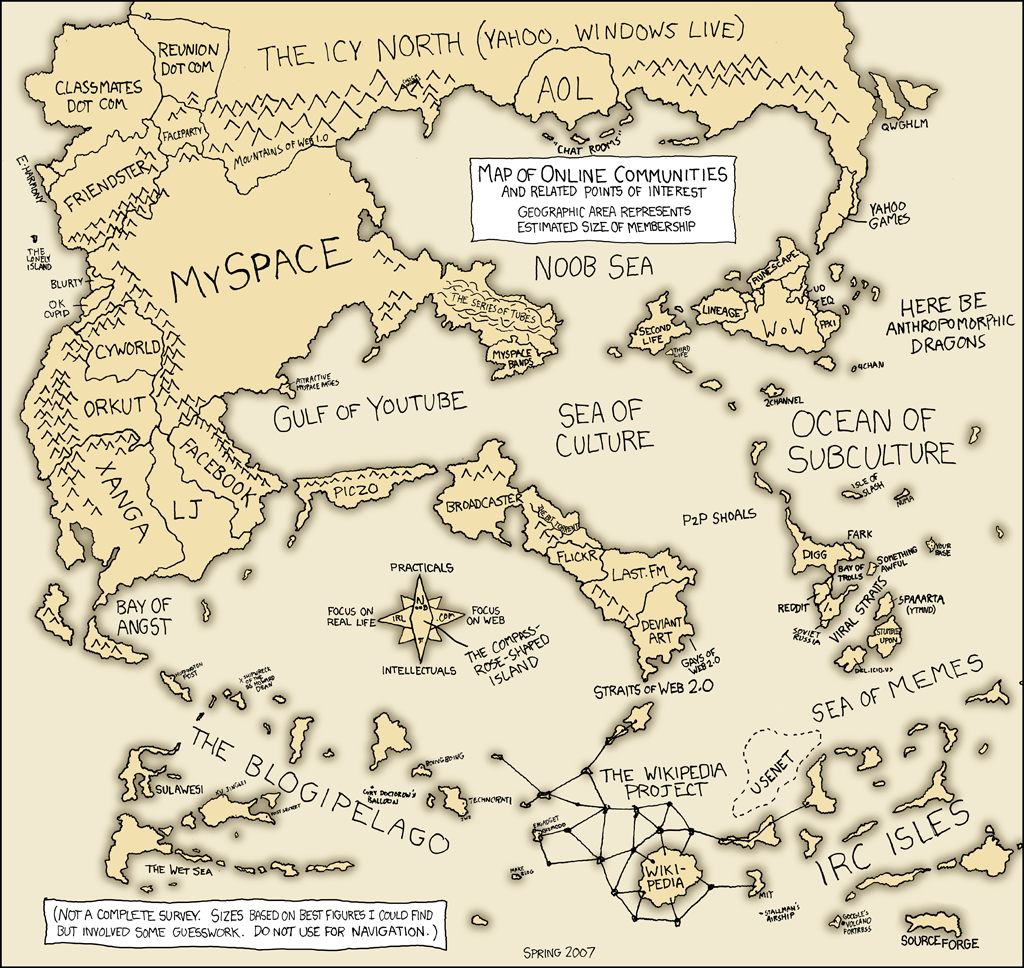
o A map of online communities.
o An open-source freeware version of SimCity will be included with every computer distributed by the One Laptop Per Child project. The idea of impoverished kids learning about mega-conceptual society-building through SimCity blows my mind, but I do worry about the hegemonic implications, that SimCity merely represents the Westernized/American notion of urban development, beginning with power plants and industrial zoning, as opposed to in a poorer economic sphere.

January 14, 2008

useful things, no. 10: write room

"Paperback Writer" - The Beatles (download, regular) (buy, karaoke)

Over the weekend, I asked Spupes how to create a user account on my computer with all temptation-abetting internet capabilities blocked. Instead, he told me about WriteRoom, a text editor that takes over the computer's full screen, literally blacking out all other apps in an emulation of a no-fuss '80s-style word processor. By necessity, a screenshot could never convey exactly what is so wonderful about this program, so I'm not gonna try. Conceptually, it raises some interesting points about the usefulness of the complex, multitask-enabling GUIs that've become the norm versus the efficiency of one-track productivity. Practically, it's just awesome. Or maybe it's just a nice change of virtually scenery after 10+ years of Microsoft word processing products. Either way, I'm looking forward to getting up tomorrow and using this.

January 8, 2008

moving entertainments

Cornelius on some kids' show:

Cornelius's music for a video game, Coloris:

David Lynch on the iPhone:

The legendary/lost/kinda-actually-sucky Biggs sequence from Star Wars:

A little old lady with an ax scares off a robber:

January 7, 2008

have read/will read dept.

o Nicholas Meriwether on the Grateful Dead moniker: "steeped in scholarship, near universal in human culture and history, and still capable -- as one Deadhead put it -- of alienating parents." (via his introduction to All Graceful Instruments, an anthology of Deadhead academia) (PDF)
o Chuck Klosterman on why not reading Harry Potter will make him culturally irrelevant at some point in the future.
o Why dudes like sappy movies, as long as they're made up (and vice-versa).
o J. Hoberman on Bob Dylan's films.
o David Cross on selling out. This is something of a genre: the confessional post about why doing X isn't selling out, or -- if it is -- why it doesn't matter a damn. (See also: Kevin Barnes.) Somebody could edit an anthology of this stuff.
o Steve Jobs at home, circa 1982.

November 12, 2007

have read/will read dept.

Today marked the first Sunday where the Times had no baseball stories. Caught up on some old bookmarks I'd never read and found a few more.
o A great Violet Blue story about the ownership of sex.com.
o Seth Stevenson's travel journal from Dubai. I imagine it's fairly impossible to file a boring story from there.
o A back door in the iTunes store to listen to Japanese pop and other delights.
o Mark Dery's "Rememberance of tacos post" begins with the immortal lede "I'm having a señor moment," and presents a brief history of Mexican food in the United States, which seems (to me) just another manifestation of the aesthetic/technological idea/ideal of realism.
o "Viewing American class divisions through Facebook and MySpace," a paper by Danah Boyd.

November 6, 2007

moving entertainments

Old news in many cases, but all great:

Priceless straight-facin' via The Onion (NSFW):

Use Of 'N-Word' May End Porn Star's Career

A preview for a shot-by-shot recreation of Raiders of the Lost Ark made by 12-year olds. Anybody have a working torrent for the full deal?

Storytime, Terry Gilliam's first movie, circa 1968:

Leave Kang alone:

As Sancho sez: "Nature is awesome."

Footage of a legendary "Dark Star" from the Fillmore East, 2/14/70:

October 29, 2007

is it time for spring training yet?

Sadly, probably not. What a lame Series. At least it's time to end the self-imposed moratorium on reading baseball books.

o The New Yorker's Ben McGrath gets loose on Scott Boras, agent to A-Rod, Carlos Beltran, and many others.
o A pair of scholarly studies about the effects of the Designated Hitter, including a PDF of "the Etiology of Public Support for the Designated Hitter Rule" (apparently, um, Democrats favor the DH more than Republicans) (Thx, MVB)
o FireJoeMorgan.com will keep me entertained during the long, cold months. Of this, I am sure. (Word, OAK.)
o Richard Ford has a nice piece in today's Times about the game-as-played versus the game-as-discussed. Anything that "refines the idea of spectatorship" is good. Anything "trying to sharpen the focus on a bunch of focusless stuff that not only doesn’t matter a toot, and could never be proven true or false and therefore isn’t really journalism, but that also doesn’t have anything to do with the game as it’s played"... well, that's bad.
o It is time for the annual reading of A. Bartlett Giamatti's "The Green Fields of the Mind."

No, seriously, is it time for spring training yet?

October 16, 2007

have read/will read dept.

o Why didn't anybody tell me there was a Mad Decent blog? All kindsa groovy/poppy/dancy jams from the world's trenches.
o Bizarro crate-dug cuts from all over the globe at the End-of-World Music blog. I recommend the Yuri Morozov.
o Bill Wasik nails the zeitgeist.
o Tom Stoppard on Syd Barrett.
o Dean Ween is blogging.

October 2, 2007

useful things, no. 9

The ninth in an ongoing collection of functional webpages and dork tools (excluding any/all Google programs)

o A guide to free wifi hotposts.
o Send free text messages to any mobile phone via the webz.
o Skip the thumbnails in Google's image search.
o Trade oodles of used CDs for credit at Spun.com and they'll even send the goods first, along with an empty box and return postage for whatever's being traded.
o It ain't free (cost me $50), and it's impossible to truly set levels, but the purchase of Griffin's iTalk gizmo seems well worth it already -- even if I haven't used it yet to tape an interview or bootleg a show. Those will come soon. Excepting an emergency flashlight next to my bed, I no longer have any device that requires a constant diet of double-A batteries. Weird!

September 21, 2007

have read/will read dept.

o Jonathan Lethem in typical nerd/pomo freefall.

o Gödel, Escher, Bach mastermind Douglas Hofstadter reviews the latest by Language Instinct brainiac Steven Pinker.

o A five-year old interview with the founders of my favorite permanent semi-floating party in Brooklyn.

o A long essay by Marcus Boon about Sublime Frequencies and ethnopsychedelic field recording.

o An even longer history of vernacular web design.

September 14, 2007

useful things, no. 8


The eighth in an ongoing collection of functional webpages and dork tools (excluding any/all Google programs)

o Virgil Griffith's WikiScanner lets you see which organizations' employees are editing Wikipedia entries.
o TV Links: full movies, TV shows, etc.., organized fairly immaculately. Like YouTube, if the Man never noticed it.
o Nobelcom.com provides international calling card codes at cut rates waaay better than the bodega.
o TubeTV allows the user save videos from YouTube and other embedded sources.
o Like Robert DeNiro's renegade plumber in Brazil NYC iPod Doctor does out-of-service/unauthorized iPod repairs on street corners -- and now, apparently, via the mails. We're all in this together.

August 13, 2007

links of dubious usefulness, no. 16

o Thurston Moore on free jazz. (Thx, SoS.)

o The original manuscript proposal for William Gibson's Spook Country. (via BB)

o A wiki-list of ballplayers' entrance music. (So Julio Franco's entrance music really was called "Everybody Get Ready, Jesus Is Coming"...)

o Douglas Wolk on leaked albums. (see also: his great James Brown reviews at Pitchfork.)

o The preview for Michel Gondry's forthcoming Be Kind Rewind:


July 31, 2007

links of dubious usefulness, no. 15

o Been perusing the Lost in Tyme crate-digging blog at Sea of Sound's recommendo. Compared to Mutant Sounds, it's positively mainstream, but still yielding some nice scores.

o The Acid Archives of Underground Sounds is a ridiculously large document of the obscurest of the obscure. They certainly don't get everybody -- a quick scan through recent Mutant Sounds posts from the genre/era reveals that -- but the sheer amount of "lost" psych records is nearly unfathomable. If only they had recommended playlists.

o A complete video of Cornelius's recent performance at the Sonar Festival. I haven't watched it yet, but assuming it's the same set I caught at Webster Hall in May, it's dome-splitting: beautiful videos synched with Cornelius's band, who groove on his bleeped abstractions in an organic way that somehow recalls the Stop Making Sense-era Talking Heads. Highly worth your time. Scroll down to find Cornelius. (Good spotting, Sancho.)

o Neutral Milk Hotel's Julian Koster (aka the Music Tapes) will be playing one of his very sporadic shows in NYC next week, which can only be attended via his special, bizarre instructions. Last time, I tried to follow them & somehow still managed to miss him (as did other people who arrived at the same time/place as me). Doesn't mean I won't try again.

o The preview for Wes Anderson's forthcoming Darjeeling Limited:

July 12, 2007

links of dubious usefulness, no. 14

o Technobrega is a new Brazilian genre whose creation and distribution is entirely based on bootlegging/free distribution/live gigs. Haven't listened to the clips yet, but its context is rad. (Thanks, RG.)
o ZoomQuilt II is extraordinarily detailed eye candy, an infinitely looped acceleration into fantastic recursive worlds. (Word, Dad.)
o Haruki Murakami on jazz.
o A nice, meaty interview with William Gibson on his forthcoming Spook Country and other topics.
o A detailed chronology of 120 years of electronic musical instruments.

June 15, 2007

links of dubious usefulness, no. 13

o Peter Tork kvetches about how the Monkees have been kept from the Rock & Roll Hall of Fame. I must respectfully disgaree with the otherwise heady folks at Hidden Track. In fact, not only would I argue that the Monkees deserve to be in the Rock & Roll Hall of Fame for their roles as pioneering cultural archetypes, but that a canned institution like the Rock & Roll Hall of Fame was veritably invented for canned bands like the Monkees. I also think it's a bit of a double-standard for them to honor those doing the canning (like, say, Phil Spector) but denying the messengers' existence.

o Some great Mets-related profiles over the past few months: Jose Valentin (and how he is a player/owner in Puerto Rico), El Duque (and an older story about his arrival in the United States on a raft), Jose Reyes (and how he's da bomb), Rick Peterson (and how he's batshit, into crystals, and could conceivably turn an Oblique Strategies deck loose on the bullpen), and -- on the cover of Sports Illustrated this week -- Omar Minaya (and the Mets' new new pan-racial funk; step over Sly Stone).

o An academic paper titled "Human Computer Interaction in Science Fiction Movies." Haven't gotten around to reading it yet, but it looks promising.

o Wunderkammern pal and Sea of Sound host Michael Slaboch contributes (along with Tony Mendoza) to the Third Coast International Audio Festival. Their "New Pleasant Revolution" is the fourth audio documentary down.

o A preview of the forthcoming (and officially sanctioned) Robot Chicken Star Wars special, out this weekend.

May 25, 2007

the coen brothers' tuileries

"Tuileries," the Coen brothers' contribution to Paris, Je T'aime, might as well be a silent short titled "Donnie Goes to Paris." To my ugly American ears, the French dialogue is just part of the soundtrack -- and, either way, is totally unnecessary to understand the story, which is conveyed via pantomime. Not a significant work by any stretch, it's still an entertaining exercise in how to retain one's own voice while working inside a genre. For the Coens, that means abusing the shit out of Steve Buscemi in some new way. (Thanks, MVB.)


March 22, 2007

links of dubious usefulness, no. 12

Yo, happy spring everybody. I'm getting hell out of Dodge until early April. Posting will sporadic 'til I get back... xoxo, jj.

o Update on The Darjeeling Limited, Wes Anderson's latest, which recently wrapped two months of shooting in India. Sounds potentially epic. (via Kottke.)

o Interesting Associated Press report about the Iraqi music industry. (see also: Sublime Frequencies' ear-opening Choubi Choubi compilation of folk & pop from Saddam-era Iraq)

o A circa 2000 email roundtable between Haruki Murakami's editor and translators.

o The blogobattalions have been all over this, but still worth passing along: a short Chris Ware animation from the forthcoming This American Life television show. I love the way his style translates to this medium. Hope he does more. (Thx, Sea of Sound.)

o Mutant Sounds blog, dedicated to uploading insanely obscure weirdo albums. (Werd, Boomy.)

o This whole episode is nutty, but fast-forward to 4:10 for the ridiculous Star Wars dorkiness:

March 9, 2007

links of dubious usefulness, no. 11

o Wired's cover feature on so-called Snack Culture ("movies, TV, songs, games... packaged like cookies or chips, in bite-size bits for high-speed munching") is a clever trend piece, even if it seems sorta token. Stephen Johnson's contrarian rebuttal, on the other hand, is more incisive, arguing that, based on our collective love of insanely long television serials like 24 and The Sopranos, our attention spans are actually getting longer.

o In regards to the latter, I quite enjoyed David Denby's overview of the recent spate of avant-narrative play in movies. "In the past, mainstream audiences notoriously resisted being jolted," he writes. "Are moviegoers bringing some new sensibility to these riddling movies?" Definitely, I think, though I'm sad that Denby didn't chase his idea even deeper into the mainstream, where movies like Stranger Than Fiction are channeling Charlie Kaufman's meta-narratives into ultimately cutesy and traditional romantic comedies.

o In regards to the former, I also recently landed back on the perennial Ronald & Nancy Reagan pro-drug mash-up, which circulated extensively via bootleg video back in the day. I vaguely remember my Dad having a copy. It's sometimes easy to forget that videos like this not only existed before YouTube but that there was a fairly established underground network that existed to distribute them. This is how the original South Park episode, "The Spirit of Christmas," circulated, too.

o In regards to all of it, if only the molecular sense, I'm fascinated by Lowe's recent campaign to "try to inject a new 'emoticon' into teens' text messaging vernacular in an effort to keep teens drinking milk." Or, if you will: :-{). I'm sure the international moustache lobby & various facial hair advocacy groups are pleased that the milk people are saving their first-quarter propaganda budgets.

o In regards to none of the above, Richard Gehr is blogging. It's one thing to expose the kidz to good music. It's another to do the same for the adultz.

March 5, 2007

useful things, no. 7

The seventh in an ongoing collection of functional webpages and dork tools (excluding any/all Google programs)

o Should you be using Entourage '01 for your email, and should you reach the 2 GB storage limit they take no measures to warn you about, and should your whole email database proceed to meltthefuckdown and corrupt your archives and cause you three days of freakation and frustardedness, I would then whole-heartedly endorse paying $18 for EntourAid.
o Handbrake allows you to easily rip mpegs from DVDs. Sadly, my laptop is way too slow to run it effectively. Someday I'll get the whole '86 series on my iPod and watch the innings in shuffle.
o iConcertCal searches your iTunes library and tells you what bands are coming to town.
o Haven't f'ed with it yet, but Peel seems like a good utility to organize blog listening.
o The iTunes linkmaker allows you to generate URLs that pop right into the iTunes store.

February 26, 2007

grapefruit league links

Grapefruit League games begin on Wednesday. (Do you like grapefruit?)

o For the first time in a decade, Major League Baseball has tweaked the rules. Some stuff, such as a new way of resolving tied games, might come into play. In most cases throughout the 14-page PDF -- the umpire placing the rosin bag on the pitcher's mound instead of carrying it with him, for example -- the changes are almost literally insignificant. Often, they exist simply to make a rule "consistent with current practice at the professional level." One uses the word "expectorate." In places, the changes excise outmoded historical statutes. They also acknowledge that any place the official rules refer to "he," it could also mean "she." If it is accepted that nobody, especially not Abner Doubleday, was singularly responsible for codifying the rules of a folk game, then -- owners and commerce aside -- it remains, like most professional sports, morphed and unconsciously micromanaged by the collective will of the participants. Official changes are, most of the time, secondary.

o The New York Times runs a nice profile Mets' bench coach Jerry Manuel. "I feel very strongly that the game has a certain flow to it," Ben Shpigel quotes Manuel as saying. "You make adjustments as it goes on." It also notes that Manuel reads Gandhi and Tolstoy, which makes him a nice match with anti-war socialist/Gabriel Garcia Marquez-reading first baseman Carlos Delgado. I like the description of Manuel finding a "secluded spot on the field" to listen to the players around him.

o From the opposite school as Manuel is J.C. Bradbury, whose Baseball Economist: The Real Game Exposed was recently published (and reviewed by the Wall Street Journal). While the book sounds mindblowingly analytical, no doubt, I guess I'm a little skeptical of the claim that statistics comprise an objective, "real" game of ball. Baseball seems much larger to me, statistics being one part of a collision that also involves the drama, tedium, life, and lives that unfold from an eight-month season that begins in late February and ends in late October. Yes, you can read a baseball game as entries into a grand database (as my friend Russ recently pointed out) and maybe there's something pure about that, but I'm not sure if i